Friday, 23 May 2014
another wee film - autumn in japan
As is my wont, I made another wee film using all my video clips from the past few months. This is autumn in Japan, in Miyazaki, Kyoto, Osaka, Nara, and Miyakonojo. Music by Alex Winston.
Thursday, 15 May 2014
what's it like in a japanese high school?
This week I'm giving a talk to a group in Miyazaki - the British-Japan Association to be precise - about Scotland, being a foreigner here, and my impressions of the schooling here. I'm a little nervous, but just keep reminding myself that I won't have to teach them anything, use gestures and illustrations to make myself understood, or raise my voice to be heard, unlike every week day. So I guess it won't be too bad.
I haven’t really written at length on the differences in attitude to education yet, so perhaps now’s as good a time as any. It might be interesting to some friends back home beginning their careers as teachers! I really admire some aspects of school life here – others not so much. I’m not saying that one approach is necessarily better than another, and I appreciate that different systems have arisen out of different social milieus and needs. Of course, I’m no expert, and this is just from my own observations in daily life.
Here are the 5 main differences between Japan and my own experience of school education, for those whom it may concern.
When I first started teaching, I was surprised at just how reluctant the students were to speak or act individually. Group or pair decisions were made by playing janken (or rock paper scissors); many seemed confused when asked for individual opinions. Indeed, far more of their assignments seem to consist of memorisation and drilling (not just in English) than in argumentation, critical thinking, or original work. It feels like knowledge is transmitted from the teacher, rather than arrived at through a more collaborative process. Furthermore, it’s rare for the kids (at least at an academic high school) to have a part time job, and for most of them, their school life takes up almost all of their time except sleeping. The uniform rules are very strict (right down to not being allowed to pluck your eyebrows, eek).
However, in many ways the kids are far more mature and independent than in my experience. They take a lot of responsibility for leading club activities and organising school events like assemblies, sports days and trips (they’re in charge of lighting, sound, cleaning up, first aid, water provisions, etc.) They do all the cleaning off the school too, everyday after lunch for ten minutes along to classical music piped into the corridors, and for hours at the start and end of term (although the school could probably do with a professional deep clean sometime soon).
They’re allowed to do far more risky things too, like sports involving running across each other’s backs, shimmying up huge poles and making giant human pyramids. At cleaning time they’re out on the window ledges sweeping. In winter they breeze past kettles full of boiling water balanced atop gas stoves, from which hazardous wires protrude (perhaps that’s just a different attitude towards health and safety). In any case, the consensus seems to be that it teaches them self-reliance and toughens them up.
Lastly, they seem far more comfortable conversing naturally with teachers and other adults. There just seems to be less of an adult/ kid, teacher/ student divide, and students confidently and respectfully address and greet teachers in the corridors and staffroom.
Which brings me on to the next point…
… is very different here. From what I can tell, teachers are deemed more responsible for the students’ whole well being and behaviour, and know a lot about their families and life outside school. They’ll drop off homework at students’ houses and know a lot about their friendships etc. And vice versa – a lot of teachers seem very open about their lives and hobbies.
Perhaps that’s part of why some students are very familiar with some popular teachers, draping their arms around them in corridors, flicking their ties or ruffling their hair! Likewise, it’s not uncommon to see a boy being playfully hit around the head with a workbook by a male teacher.
And yet it seems that this is all built on a foundation of mutual respect. Students and teachers address each other formally; students say a formal greeting and explanation before entering the staffroom; they thank the teachers with tears in their eyes at graduation; and it seems rare for a teacher to publicly scold or get angry with a student, let alone send them out of class. Each class is started and finished with a formal “onegaishimasu” and “arigato gozaimashita” with bowing.
Indeed this close relationship seems to foster a different attitude to discipline. Students might talk or sleep in class, but instead of demanding uniform attention, the group dynamic is allowed to keep the class flowing. It seems that a lot of rule breaking is dealt with by lengthy conversations, with students apologising and discussing their misdemeanour with several teachers in turn. A boy who recently cheated in an exam is being isolated from his peers for a week, while various teachers visit him to discuss what he did and try to change his attitude.
The harmony of the group seems to be very important, and conflict is dealt with using exclusion from and reintegration into that group. I find this attitude of mutual respect is a pleasant change from the all-too common dynamic of an indifference, hostility and distance that can arise between teachers and students.
Instead of students moving between classes, teachers have their desk in the large staffroom and move between rooms, carrying all their materials in a basket (unless it’s art or chemistry etc). The staffroom seems like the hub: students come and go with questions and papers, traveling salesman go from desk to desk with new textbooks, bento vendors and cooks delivery lunches in boxes. Yet this is one aspect I’ve actually found quite difficult. Sometimes it feels more like the students ‘own’ the classroom and thus the class rather than the teacher – but perhaps that perception just comes from my preconceived idea of a teacher’s role.
Nevertheless, I have very fond memories of my favourite teacher’s room from high school. Our history classroom was a little treasure box with not an inch of wall peeking through posters, poems, pictures, old wardrobes and jukeboxes and sewing machines, diagrams, plants, books we could borrow to take home, jars of coins we would give to charity each year, strange postcards and ancient coins. The atmosphere was inspiring and we felt like co-conspirators when we were in it. Our teacher was an enigmatic bald Glaswegian about whom rumours circulated – he’d been a microbiologist, he’d been in the army, he’d been a priest – and who changed his look every few years and then wore the same outfit and pair of glasses every day. Kind of like Dr Who actually… He would use these objects from his room, as well as snatches of songs, youtube clips and projections, to make the subject come alive.
In school here, the classrooms consist of desks and chairs, a lectern-desk at the front, a blackboard with chalk, and a cleaning cupboard at the back. Using technology or any other materials than notebooks is a bothersome affair. As an ALT, I know it would be a lot easier to enthuse the kids with the use of different media. But, necessity is the mother of invention.
This still constantly surprises me. Students arrive at school between 7.30 and 8.30, often rising earlier to do homework. Rather than doing several extra curriculars, they choose one club activity and commit to it like crazy, practicing till past 6 several times a week after the 4.30 school finish. They also are expected to participate for hours every weekend (as are the teachers who oversee them). After this, many of them go to cram school till as late as midnight, then finish other homework into the early hours of the morning. It’s not uncommon for these growing teenagers to be getting 4 hours of sleep a night.
I truly respect my students and colleagues commitment and dedication. Their self-discipline is remarkable, especially compared to the little we expect of teenagers back home. The students have little time to be bored and commit petty crime, and they’re part of a structured social world that is perhaps a good antidote to the alienation many teenagers feel.
Yet I do worry quite a lot about their health. Lack of sleep is seen as an indicator of loyalty to the school and determination. For a country that is very aware of physical health (more on that later), lack of sleep is disregarded in favour of cramming all too often. Teenagers at this age need plenty of sleep so that their memory and mental growth is unimpeded – and it’s also vital to avoid depression, anxiety and other mental disorders, let alone the more tangible health effects later in life.
There’s also the fact that hard work isn't always good or creative work, and long hours don’t always signify productivity. I want my students to have time to develop curiosity about personal interests, to have the leisure necessary to be creative, to make their own connections and form their own opinions. Sometimes it’s necessary to be bit bored – it gives your brain the space to think laterally. So much of what I ‘learned’ in high school came from reading novels on my bed at 4pm; catching random documentaries after the 10 o’clock news; conversations with friends in shops after school. I think that the emphasis on ‘productive’, group activity needs to be balanced by some more individual downtime.
All through the winter months, my mailbox was bombarded with pamphlets featuring cartoons of runny noses and thermometers. People were on constant guard against catching ‘influenza’, and indeed whole classes were often sent home for days at a time to contain flu outbreaks (I don’t know if it’s more strains or more susceptibility). People were very concerned about wrapping up warm, eating healthily and not going out too much.
This was all very well except that Japanese buildings are built for sweltering summer months and have no central heating. Multiple electric heaters at strategic points, an electric blanket, and the kotatsu heater under my dining table kept my flat livable. At school, no one took off their coats and huddled around gas stoves in temperatures that would have had Scottish students sent home. Still, it was do-able.
Except for the fact that all the windows would be kept open! Freezing breezes blew through the school as staff clutched hand warmers and hot water bottles, and students worked with blankets across their legs. The theory behind it was that the fresh air keeps us healthy, gives us strong bodies and stops us catching a cold… needless to say this reasoning was lost on me.
When this method didn’t work and I did get ill, everyone wanted to know my exact temperature and how it differed from the normal figure. They seemed confused that I could just feel or know that I had a fever. At the doctor’s I was given 3 different types of medication, even though I mainly went there so I could take sick leave. Most teachers use up all of their annual leave before even thinking of taking sick leave, even for surgery, so a doctor’s certificate was necessary. One ALT had to get out of bed and be taken to the doctor every day to get such a certificate, thus prolonging her recovery period somewhat.
The last thing to get used to was everyone wearing the famous white masks, covering everything below the eyes: they’re worn as a matter of courtesy to the people around you if you’re sick. Of course, this proved a little difficult in English class. However, it was kind of nice being given Grandmotherly advice by teachers and students alike every day and being urged to “Please take care of your health Sophie sensei!”
• The noises in the classroom. Teachers gargle, spit in sinks, talk to themselves, yawn, clear their throats and groan in way unlike any other office environment I’ve been in!
• Work parties. A big part of teaching is socialising with other teachers in numerous drinking and dinner parties at different times in the year – I’ve gone out with my department teachers, female department teachers, year group teachers, new teachers and leaving teachers. Everyone knows and socialises with each other. If you go on a trip, a box of omiyage (generally edible treats) is expected to thank everyone for working while you were not.
• Dealing with bereavement. A colleague recently lost his mother and I was unsure what the normal behaviour was. Back home I would definitely send a card or let them know somehow that I was sorry for their loss. Here, the norm is to give some money as a group to the person. When I asked, I was told that it was better just to say, “I’m happy to see you” or something similar.
• The interactions of male students. I often see the boys sit in each other’s laps while completing an activity, massage each others’ shoulders and generally interact in a far more tactile way than schoolboys from back home.
• Tooth brushing! Every day after lunch students and teachers go about their business with a mouthful of foam and a toothbrush sticking out the side!
• Is the modern school system really preparing young people for their future?
• How about further education?
• Perhaps too many rules are diluting what children learn from play
• The importance of freedom and playing in children’s growth
I’d love to know the thoughts of any fellow ALTs or teachers back home, especially if you’ve had a different experience than me!
I haven’t really written at length on the differences in attitude to education yet, so perhaps now’s as good a time as any. It might be interesting to some friends back home beginning their careers as teachers! I really admire some aspects of school life here – others not so much. I’m not saying that one approach is necessarily better than another, and I appreciate that different systems have arisen out of different social milieus and needs. Of course, I’m no expert, and this is just from my own observations in daily life.
Here are the 5 main differences between Japan and my own experience of school education, for those whom it may concern.
1) A different approach to independence
When I first started teaching, I was surprised at just how reluctant the students were to speak or act individually. Group or pair decisions were made by playing janken (or rock paper scissors); many seemed confused when asked for individual opinions. Indeed, far more of their assignments seem to consist of memorisation and drilling (not just in English) than in argumentation, critical thinking, or original work. It feels like knowledge is transmitted from the teacher, rather than arrived at through a more collaborative process. Furthermore, it’s rare for the kids (at least at an academic high school) to have a part time job, and for most of them, their school life takes up almost all of their time except sleeping. The uniform rules are very strict (right down to not being allowed to pluck your eyebrows, eek).
However, in many ways the kids are far more mature and independent than in my experience. They take a lot of responsibility for leading club activities and organising school events like assemblies, sports days and trips (they’re in charge of lighting, sound, cleaning up, first aid, water provisions, etc.) They do all the cleaning off the school too, everyday after lunch for ten minutes along to classical music piped into the corridors, and for hours at the start and end of term (although the school could probably do with a professional deep clean sometime soon).
They’re allowed to do far more risky things too, like sports involving running across each other’s backs, shimmying up huge poles and making giant human pyramids. At cleaning time they’re out on the window ledges sweeping. In winter they breeze past kettles full of boiling water balanced atop gas stoves, from which hazardous wires protrude (perhaps that’s just a different attitude towards health and safety). In any case, the consensus seems to be that it teaches them self-reliance and toughens them up.
 |
| Waiting for the storm to pass over at sports day rehearsal |
Lastly, they seem far more comfortable conversing naturally with teachers and other adults. There just seems to be less of an adult/ kid, teacher/ student divide, and students confidently and respectfully address and greet teachers in the corridors and staffroom.
Which brings me on to the next point…
2) The student teacher relationship
… is very different here. From what I can tell, teachers are deemed more responsible for the students’ whole well being and behaviour, and know a lot about their families and life outside school. They’ll drop off homework at students’ houses and know a lot about their friendships etc. And vice versa – a lot of teachers seem very open about their lives and hobbies.
Perhaps that’s part of why some students are very familiar with some popular teachers, draping their arms around them in corridors, flicking their ties or ruffling their hair! Likewise, it’s not uncommon to see a boy being playfully hit around the head with a workbook by a male teacher.
And yet it seems that this is all built on a foundation of mutual respect. Students and teachers address each other formally; students say a formal greeting and explanation before entering the staffroom; they thank the teachers with tears in their eyes at graduation; and it seems rare for a teacher to publicly scold or get angry with a student, let alone send them out of class. Each class is started and finished with a formal “onegaishimasu” and “arigato gozaimashita” with bowing.
Indeed this close relationship seems to foster a different attitude to discipline. Students might talk or sleep in class, but instead of demanding uniform attention, the group dynamic is allowed to keep the class flowing. It seems that a lot of rule breaking is dealt with by lengthy conversations, with students apologising and discussing their misdemeanour with several teachers in turn. A boy who recently cheated in an exam is being isolated from his peers for a week, while various teachers visit him to discuss what he did and try to change his attitude.
The harmony of the group seems to be very important, and conflict is dealt with using exclusion from and reintegration into that group. I find this attitude of mutual respect is a pleasant change from the all-too common dynamic of an indifference, hostility and distance that can arise between teachers and students.
 |
| Playing shiritori at the end of term |
3) The classroom set-up
Instead of students moving between classes, teachers have their desk in the large staffroom and move between rooms, carrying all their materials in a basket (unless it’s art or chemistry etc). The staffroom seems like the hub: students come and go with questions and papers, traveling salesman go from desk to desk with new textbooks, bento vendors and cooks delivery lunches in boxes. Yet this is one aspect I’ve actually found quite difficult. Sometimes it feels more like the students ‘own’ the classroom and thus the class rather than the teacher – but perhaps that perception just comes from my preconceived idea of a teacher’s role.
Nevertheless, I have very fond memories of my favourite teacher’s room from high school. Our history classroom was a little treasure box with not an inch of wall peeking through posters, poems, pictures, old wardrobes and jukeboxes and sewing machines, diagrams, plants, books we could borrow to take home, jars of coins we would give to charity each year, strange postcards and ancient coins. The atmosphere was inspiring and we felt like co-conspirators when we were in it. Our teacher was an enigmatic bald Glaswegian about whom rumours circulated – he’d been a microbiologist, he’d been in the army, he’d been a priest – and who changed his look every few years and then wore the same outfit and pair of glasses every day. Kind of like Dr Who actually… He would use these objects from his room, as well as snatches of songs, youtube clips and projections, to make the subject come alive.
In school here, the classrooms consist of desks and chairs, a lectern-desk at the front, a blackboard with chalk, and a cleaning cupboard at the back. Using technology or any other materials than notebooks is a bothersome affair. As an ALT, I know it would be a lot easier to enthuse the kids with the use of different media. But, necessity is the mother of invention.
 |
| One of my first self-introduction lessons. I have since realised not to stand in front of the projector |
4) The work ethic
This still constantly surprises me. Students arrive at school between 7.30 and 8.30, often rising earlier to do homework. Rather than doing several extra curriculars, they choose one club activity and commit to it like crazy, practicing till past 6 several times a week after the 4.30 school finish. They also are expected to participate for hours every weekend (as are the teachers who oversee them). After this, many of them go to cram school till as late as midnight, then finish other homework into the early hours of the morning. It’s not uncommon for these growing teenagers to be getting 4 hours of sleep a night.
I truly respect my students and colleagues commitment and dedication. Their self-discipline is remarkable, especially compared to the little we expect of teenagers back home. The students have little time to be bored and commit petty crime, and they’re part of a structured social world that is perhaps a good antidote to the alienation many teenagers feel.
Yet I do worry quite a lot about their health. Lack of sleep is seen as an indicator of loyalty to the school and determination. For a country that is very aware of physical health (more on that later), lack of sleep is disregarded in favour of cramming all too often. Teenagers at this age need plenty of sleep so that their memory and mental growth is unimpeded – and it’s also vital to avoid depression, anxiety and other mental disorders, let alone the more tangible health effects later in life.
There’s also the fact that hard work isn't always good or creative work, and long hours don’t always signify productivity. I want my students to have time to develop curiosity about personal interests, to have the leisure necessary to be creative, to make their own connections and form their own opinions. Sometimes it’s necessary to be bit bored – it gives your brain the space to think laterally. So much of what I ‘learned’ in high school came from reading novels on my bed at 4pm; catching random documentaries after the 10 o’clock news; conversations with friends in shops after school. I think that the emphasis on ‘productive’, group activity needs to be balanced by some more individual downtime.
 |
| Singing the Miyazaki anthem with the Miyazaki mascots |
5) The attitude to health
All through the winter months, my mailbox was bombarded with pamphlets featuring cartoons of runny noses and thermometers. People were on constant guard against catching ‘influenza’, and indeed whole classes were often sent home for days at a time to contain flu outbreaks (I don’t know if it’s more strains or more susceptibility). People were very concerned about wrapping up warm, eating healthily and not going out too much.
This was all very well except that Japanese buildings are built for sweltering summer months and have no central heating. Multiple electric heaters at strategic points, an electric blanket, and the kotatsu heater under my dining table kept my flat livable. At school, no one took off their coats and huddled around gas stoves in temperatures that would have had Scottish students sent home. Still, it was do-able.
Except for the fact that all the windows would be kept open! Freezing breezes blew through the school as staff clutched hand warmers and hot water bottles, and students worked with blankets across their legs. The theory behind it was that the fresh air keeps us healthy, gives us strong bodies and stops us catching a cold… needless to say this reasoning was lost on me.
When this method didn’t work and I did get ill, everyone wanted to know my exact temperature and how it differed from the normal figure. They seemed confused that I could just feel or know that I had a fever. At the doctor’s I was given 3 different types of medication, even though I mainly went there so I could take sick leave. Most teachers use up all of their annual leave before even thinking of taking sick leave, even for surgery, so a doctor’s certificate was necessary. One ALT had to get out of bed and be taken to the doctor every day to get such a certificate, thus prolonging her recovery period somewhat.
The last thing to get used to was everyone wearing the famous white masks, covering everything below the eyes: they’re worn as a matter of courtesy to the people around you if you’re sick. Of course, this proved a little difficult in English class. However, it was kind of nice being given Grandmotherly advice by teachers and students alike every day and being urged to “Please take care of your health Sophie sensei!”
Aside from those things, there were some other little surprises I encountered when I started working here -
• The noises in the classroom. Teachers gargle, spit in sinks, talk to themselves, yawn, clear their throats and groan in way unlike any other office environment I’ve been in!
• Work parties. A big part of teaching is socialising with other teachers in numerous drinking and dinner parties at different times in the year – I’ve gone out with my department teachers, female department teachers, year group teachers, new teachers and leaving teachers. Everyone knows and socialises with each other. If you go on a trip, a box of omiyage (generally edible treats) is expected to thank everyone for working while you were not.
• Dealing with bereavement. A colleague recently lost his mother and I was unsure what the normal behaviour was. Back home I would definitely send a card or let them know somehow that I was sorry for their loss. Here, the norm is to give some money as a group to the person. When I asked, I was told that it was better just to say, “I’m happy to see you” or something similar.
• The interactions of male students. I often see the boys sit in each other’s laps while completing an activity, massage each others’ shoulders and generally interact in a far more tactile way than schoolboys from back home.
• Tooth brushing! Every day after lunch students and teachers go about their business with a mouthful of foam and a toothbrush sticking out the side!
To finish, here are a few links that got me thinking about young people and education recently.
• Is the modern school system really preparing young people for their future?
• How about further education?
• Perhaps too many rules are diluting what children learn from play
• The importance of freedom and playing in children’s growth
I’d love to know the thoughts of any fellow ALTs or teachers back home, especially if you’ve had a different experience than me!
Monday, 12 May 2014
beppu

Only a month or so late, here finally is a post about Gabby and my trip to Beppu. We took an afternoon train and ventured out into the ever-so-sulphurous twilight. Beppu is famous for its natural hot springs, or onsen, and was transformed into something of a pleasure resort beginning in the 1920s.

 |
| Engrish or a strange kind of genius? |


 |
Oniishibozu Hell, named after the mud bubbles which supposedly resemble shaven monks' heads.  |

 |
| OMFG IT'S LIL SEBASTIAN |

The next hells featured a somewhat sad zoo (the Japanese care of animals leaves a lot to be desired) and crowded pens of huge alligators.


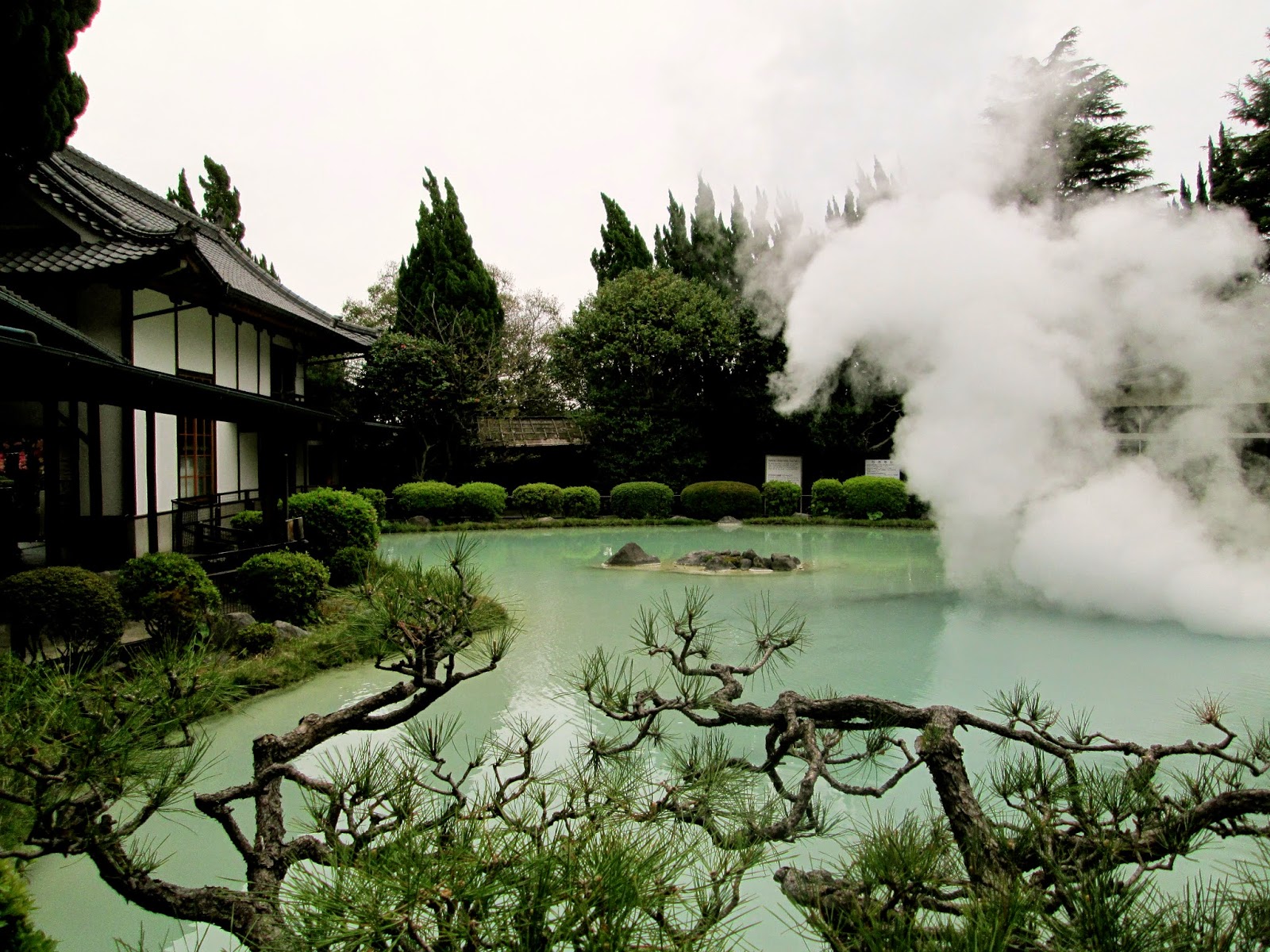 |
| Shiraike Jogoku or "white pond hell" had milky water and a strange little aquarium/ tapestry building attached. |


 |
| Kamado jigoku or "cooking pot hell", where you can drink the spring, inhale the steam, or eat puddings baked in the fumes. |
 |
| It also has a fantastic marketing campaign. |


 |
| We flicked a switch and our bath was full in 5 minutes. |

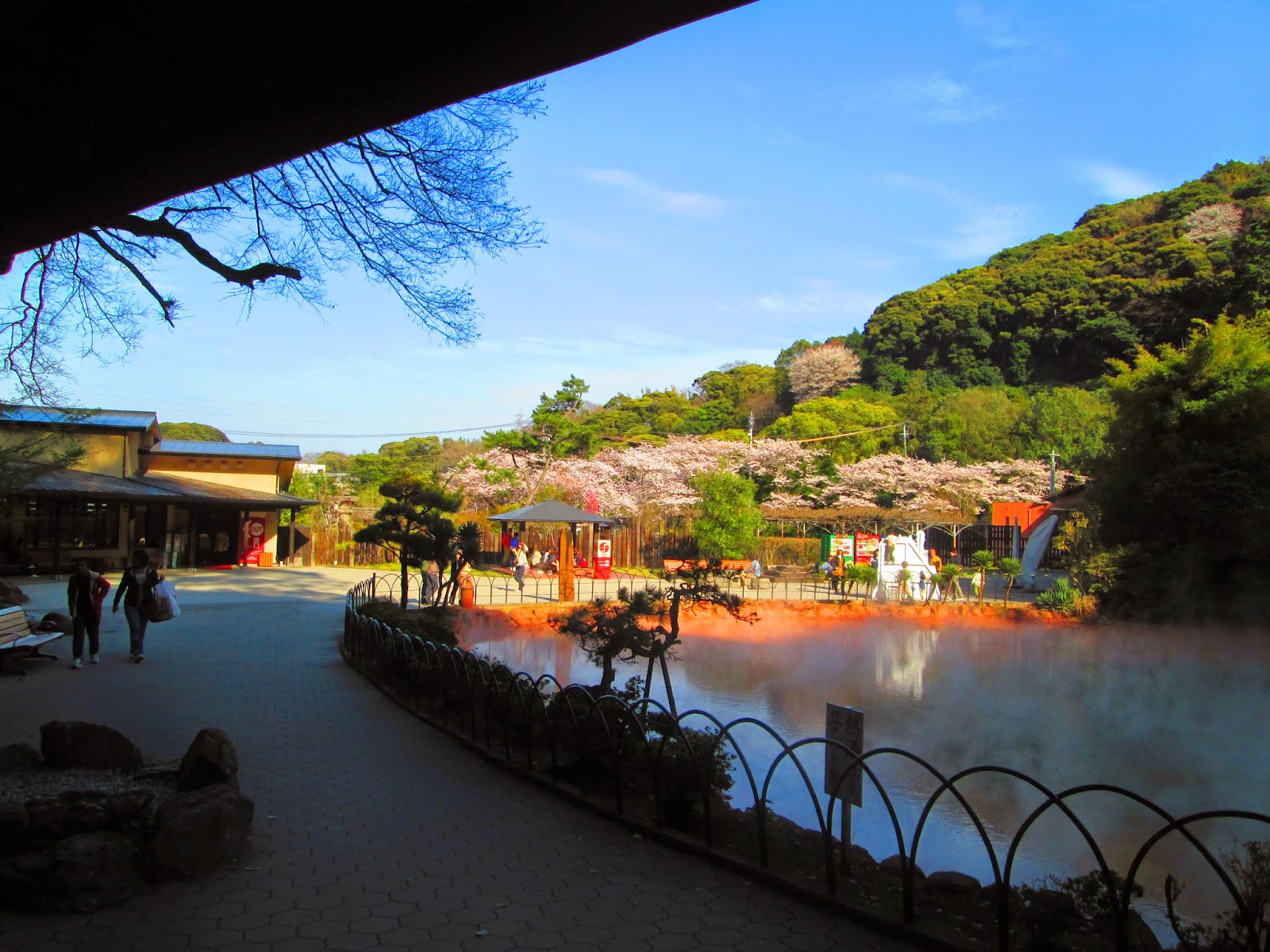
Refreshed and very clean, we finished our tour at "the blood pond hell."



 |
| The man who transformed Beppu (and fan). I think his nickname was something like The Shiny Uncle! |


Beppu was sweet and relaxed, and I think we spent just the right amount of time there.
Thursday, 8 May 2014
tonight
We drove home from taiko practice, the shrine dog's barks echoing around the mountain. At the bottom of the hill we stopped. The road stretched straight ahead, fields and trees on either side. We heard the drums faintly but they were drowned out by frogs, cicadas, crickets, bats. The night smelled pungent and heady, a quarter moon shining dully on the cedars. Wandering along the road, the kei car's lights flashed orange behind us as we chased after fireflies, the first I've ever seen. They glowed a fresh green in slow flashes, the length of a breath.
yakushima
It seems like just last week, but it's now over a month since I visited Yakushima. On a long weekend at the end of March (a really good time to go), four other ALTs and I took the hydrofoil ferry from Kagoshima Port to the mist-shrouded island that inspired the magical anime film Princess Mononoke.


At dinner, the drinks categories were "Love", "Lupin", "Star Wars" and "Strong", naturally. Our waiter lowered my "Red Lightsaber" to the table with the bvhoom-bvhoom sound-effects of the real thing.


 |
| Hey there lil buddy |


 |
| Freaked out by the tree demon |


 |
| Evening sun |
 |
| Luke really did very well putting up with us |


Sushi, beer and silly games of "Would you rather..." in the hostel followed. It was a wonderful start to the end of term break with four of my favourite people.
Subscribe to:
Posts (Atom)