Showing posts with label links. Show all posts
Showing posts with label links. Show all posts
Thursday, 12 June 2014
two island nations
A while ago I wrote a piece for the prefectural office in Miyazaki about the similarities between Japan and the UK and a few of my mishaps in negotiating them. It's finally up on the site so here's the link!
Thursday, 15 May 2014
what's it like in a japanese high school?
This week I'm giving a talk to a group in Miyazaki - the British-Japan Association to be precise - about Scotland, being a foreigner here, and my impressions of the schooling here. I'm a little nervous, but just keep reminding myself that I won't have to teach them anything, use gestures and illustrations to make myself understood, or raise my voice to be heard, unlike every week day. So I guess it won't be too bad.
I haven’t really written at length on the differences in attitude to education yet, so perhaps now’s as good a time as any. It might be interesting to some friends back home beginning their careers as teachers! I really admire some aspects of school life here – others not so much. I’m not saying that one approach is necessarily better than another, and I appreciate that different systems have arisen out of different social milieus and needs. Of course, I’m no expert, and this is just from my own observations in daily life.
Here are the 5 main differences between Japan and my own experience of school education, for those whom it may concern.
When I first started teaching, I was surprised at just how reluctant the students were to speak or act individually. Group or pair decisions were made by playing janken (or rock paper scissors); many seemed confused when asked for individual opinions. Indeed, far more of their assignments seem to consist of memorisation and drilling (not just in English) than in argumentation, critical thinking, or original work. It feels like knowledge is transmitted from the teacher, rather than arrived at through a more collaborative process. Furthermore, it’s rare for the kids (at least at an academic high school) to have a part time job, and for most of them, their school life takes up almost all of their time except sleeping. The uniform rules are very strict (right down to not being allowed to pluck your eyebrows, eek).
However, in many ways the kids are far more mature and independent than in my experience. They take a lot of responsibility for leading club activities and organising school events like assemblies, sports days and trips (they’re in charge of lighting, sound, cleaning up, first aid, water provisions, etc.) They do all the cleaning off the school too, everyday after lunch for ten minutes along to classical music piped into the corridors, and for hours at the start and end of term (although the school could probably do with a professional deep clean sometime soon).
They’re allowed to do far more risky things too, like sports involving running across each other’s backs, shimmying up huge poles and making giant human pyramids. At cleaning time they’re out on the window ledges sweeping. In winter they breeze past kettles full of boiling water balanced atop gas stoves, from which hazardous wires protrude (perhaps that’s just a different attitude towards health and safety). In any case, the consensus seems to be that it teaches them self-reliance and toughens them up.
Lastly, they seem far more comfortable conversing naturally with teachers and other adults. There just seems to be less of an adult/ kid, teacher/ student divide, and students confidently and respectfully address and greet teachers in the corridors and staffroom.
Which brings me on to the next point…
… is very different here. From what I can tell, teachers are deemed more responsible for the students’ whole well being and behaviour, and know a lot about their families and life outside school. They’ll drop off homework at students’ houses and know a lot about their friendships etc. And vice versa – a lot of teachers seem very open about their lives and hobbies.
Perhaps that’s part of why some students are very familiar with some popular teachers, draping their arms around them in corridors, flicking their ties or ruffling their hair! Likewise, it’s not uncommon to see a boy being playfully hit around the head with a workbook by a male teacher.
And yet it seems that this is all built on a foundation of mutual respect. Students and teachers address each other formally; students say a formal greeting and explanation before entering the staffroom; they thank the teachers with tears in their eyes at graduation; and it seems rare for a teacher to publicly scold or get angry with a student, let alone send them out of class. Each class is started and finished with a formal “onegaishimasu” and “arigato gozaimashita” with bowing.
Indeed this close relationship seems to foster a different attitude to discipline. Students might talk or sleep in class, but instead of demanding uniform attention, the group dynamic is allowed to keep the class flowing. It seems that a lot of rule breaking is dealt with by lengthy conversations, with students apologising and discussing their misdemeanour with several teachers in turn. A boy who recently cheated in an exam is being isolated from his peers for a week, while various teachers visit him to discuss what he did and try to change his attitude.
The harmony of the group seems to be very important, and conflict is dealt with using exclusion from and reintegration into that group. I find this attitude of mutual respect is a pleasant change from the all-too common dynamic of an indifference, hostility and distance that can arise between teachers and students.
Instead of students moving between classes, teachers have their desk in the large staffroom and move between rooms, carrying all their materials in a basket (unless it’s art or chemistry etc). The staffroom seems like the hub: students come and go with questions and papers, traveling salesman go from desk to desk with new textbooks, bento vendors and cooks delivery lunches in boxes. Yet this is one aspect I’ve actually found quite difficult. Sometimes it feels more like the students ‘own’ the classroom and thus the class rather than the teacher – but perhaps that perception just comes from my preconceived idea of a teacher’s role.
Nevertheless, I have very fond memories of my favourite teacher’s room from high school. Our history classroom was a little treasure box with not an inch of wall peeking through posters, poems, pictures, old wardrobes and jukeboxes and sewing machines, diagrams, plants, books we could borrow to take home, jars of coins we would give to charity each year, strange postcards and ancient coins. The atmosphere was inspiring and we felt like co-conspirators when we were in it. Our teacher was an enigmatic bald Glaswegian about whom rumours circulated – he’d been a microbiologist, he’d been in the army, he’d been a priest – and who changed his look every few years and then wore the same outfit and pair of glasses every day. Kind of like Dr Who actually… He would use these objects from his room, as well as snatches of songs, youtube clips and projections, to make the subject come alive.
In school here, the classrooms consist of desks and chairs, a lectern-desk at the front, a blackboard with chalk, and a cleaning cupboard at the back. Using technology or any other materials than notebooks is a bothersome affair. As an ALT, I know it would be a lot easier to enthuse the kids with the use of different media. But, necessity is the mother of invention.
This still constantly surprises me. Students arrive at school between 7.30 and 8.30, often rising earlier to do homework. Rather than doing several extra curriculars, they choose one club activity and commit to it like crazy, practicing till past 6 several times a week after the 4.30 school finish. They also are expected to participate for hours every weekend (as are the teachers who oversee them). After this, many of them go to cram school till as late as midnight, then finish other homework into the early hours of the morning. It’s not uncommon for these growing teenagers to be getting 4 hours of sleep a night.
I truly respect my students and colleagues commitment and dedication. Their self-discipline is remarkable, especially compared to the little we expect of teenagers back home. The students have little time to be bored and commit petty crime, and they’re part of a structured social world that is perhaps a good antidote to the alienation many teenagers feel.
Yet I do worry quite a lot about their health. Lack of sleep is seen as an indicator of loyalty to the school and determination. For a country that is very aware of physical health (more on that later), lack of sleep is disregarded in favour of cramming all too often. Teenagers at this age need plenty of sleep so that their memory and mental growth is unimpeded – and it’s also vital to avoid depression, anxiety and other mental disorders, let alone the more tangible health effects later in life.
There’s also the fact that hard work isn't always good or creative work, and long hours don’t always signify productivity. I want my students to have time to develop curiosity about personal interests, to have the leisure necessary to be creative, to make their own connections and form their own opinions. Sometimes it’s necessary to be bit bored – it gives your brain the space to think laterally. So much of what I ‘learned’ in high school came from reading novels on my bed at 4pm; catching random documentaries after the 10 o’clock news; conversations with friends in shops after school. I think that the emphasis on ‘productive’, group activity needs to be balanced by some more individual downtime.
All through the winter months, my mailbox was bombarded with pamphlets featuring cartoons of runny noses and thermometers. People were on constant guard against catching ‘influenza’, and indeed whole classes were often sent home for days at a time to contain flu outbreaks (I don’t know if it’s more strains or more susceptibility). People were very concerned about wrapping up warm, eating healthily and not going out too much.
This was all very well except that Japanese buildings are built for sweltering summer months and have no central heating. Multiple electric heaters at strategic points, an electric blanket, and the kotatsu heater under my dining table kept my flat livable. At school, no one took off their coats and huddled around gas stoves in temperatures that would have had Scottish students sent home. Still, it was do-able.
Except for the fact that all the windows would be kept open! Freezing breezes blew through the school as staff clutched hand warmers and hot water bottles, and students worked with blankets across their legs. The theory behind it was that the fresh air keeps us healthy, gives us strong bodies and stops us catching a cold… needless to say this reasoning was lost on me.
When this method didn’t work and I did get ill, everyone wanted to know my exact temperature and how it differed from the normal figure. They seemed confused that I could just feel or know that I had a fever. At the doctor’s I was given 3 different types of medication, even though I mainly went there so I could take sick leave. Most teachers use up all of their annual leave before even thinking of taking sick leave, even for surgery, so a doctor’s certificate was necessary. One ALT had to get out of bed and be taken to the doctor every day to get such a certificate, thus prolonging her recovery period somewhat.
The last thing to get used to was everyone wearing the famous white masks, covering everything below the eyes: they’re worn as a matter of courtesy to the people around you if you’re sick. Of course, this proved a little difficult in English class. However, it was kind of nice being given Grandmotherly advice by teachers and students alike every day and being urged to “Please take care of your health Sophie sensei!”
• The noises in the classroom. Teachers gargle, spit in sinks, talk to themselves, yawn, clear their throats and groan in way unlike any other office environment I’ve been in!
• Work parties. A big part of teaching is socialising with other teachers in numerous drinking and dinner parties at different times in the year – I’ve gone out with my department teachers, female department teachers, year group teachers, new teachers and leaving teachers. Everyone knows and socialises with each other. If you go on a trip, a box of omiyage (generally edible treats) is expected to thank everyone for working while you were not.
• Dealing with bereavement. A colleague recently lost his mother and I was unsure what the normal behaviour was. Back home I would definitely send a card or let them know somehow that I was sorry for their loss. Here, the norm is to give some money as a group to the person. When I asked, I was told that it was better just to say, “I’m happy to see you” or something similar.
• The interactions of male students. I often see the boys sit in each other’s laps while completing an activity, massage each others’ shoulders and generally interact in a far more tactile way than schoolboys from back home.
• Tooth brushing! Every day after lunch students and teachers go about their business with a mouthful of foam and a toothbrush sticking out the side!
• Is the modern school system really preparing young people for their future?
• How about further education?
• Perhaps too many rules are diluting what children learn from play
• The importance of freedom and playing in children’s growth
I’d love to know the thoughts of any fellow ALTs or teachers back home, especially if you’ve had a different experience than me!
I haven’t really written at length on the differences in attitude to education yet, so perhaps now’s as good a time as any. It might be interesting to some friends back home beginning their careers as teachers! I really admire some aspects of school life here – others not so much. I’m not saying that one approach is necessarily better than another, and I appreciate that different systems have arisen out of different social milieus and needs. Of course, I’m no expert, and this is just from my own observations in daily life.
Here are the 5 main differences between Japan and my own experience of school education, for those whom it may concern.
1) A different approach to independence
When I first started teaching, I was surprised at just how reluctant the students were to speak or act individually. Group or pair decisions were made by playing janken (or rock paper scissors); many seemed confused when asked for individual opinions. Indeed, far more of their assignments seem to consist of memorisation and drilling (not just in English) than in argumentation, critical thinking, or original work. It feels like knowledge is transmitted from the teacher, rather than arrived at through a more collaborative process. Furthermore, it’s rare for the kids (at least at an academic high school) to have a part time job, and for most of them, their school life takes up almost all of their time except sleeping. The uniform rules are very strict (right down to not being allowed to pluck your eyebrows, eek).
However, in many ways the kids are far more mature and independent than in my experience. They take a lot of responsibility for leading club activities and organising school events like assemblies, sports days and trips (they’re in charge of lighting, sound, cleaning up, first aid, water provisions, etc.) They do all the cleaning off the school too, everyday after lunch for ten minutes along to classical music piped into the corridors, and for hours at the start and end of term (although the school could probably do with a professional deep clean sometime soon).
They’re allowed to do far more risky things too, like sports involving running across each other’s backs, shimmying up huge poles and making giant human pyramids. At cleaning time they’re out on the window ledges sweeping. In winter they breeze past kettles full of boiling water balanced atop gas stoves, from which hazardous wires protrude (perhaps that’s just a different attitude towards health and safety). In any case, the consensus seems to be that it teaches them self-reliance and toughens them up.
 |
| Waiting for the storm to pass over at sports day rehearsal |
Lastly, they seem far more comfortable conversing naturally with teachers and other adults. There just seems to be less of an adult/ kid, teacher/ student divide, and students confidently and respectfully address and greet teachers in the corridors and staffroom.
Which brings me on to the next point…
2) The student teacher relationship
… is very different here. From what I can tell, teachers are deemed more responsible for the students’ whole well being and behaviour, and know a lot about their families and life outside school. They’ll drop off homework at students’ houses and know a lot about their friendships etc. And vice versa – a lot of teachers seem very open about their lives and hobbies.
Perhaps that’s part of why some students are very familiar with some popular teachers, draping their arms around them in corridors, flicking their ties or ruffling their hair! Likewise, it’s not uncommon to see a boy being playfully hit around the head with a workbook by a male teacher.
And yet it seems that this is all built on a foundation of mutual respect. Students and teachers address each other formally; students say a formal greeting and explanation before entering the staffroom; they thank the teachers with tears in their eyes at graduation; and it seems rare for a teacher to publicly scold or get angry with a student, let alone send them out of class. Each class is started and finished with a formal “onegaishimasu” and “arigato gozaimashita” with bowing.
Indeed this close relationship seems to foster a different attitude to discipline. Students might talk or sleep in class, but instead of demanding uniform attention, the group dynamic is allowed to keep the class flowing. It seems that a lot of rule breaking is dealt with by lengthy conversations, with students apologising and discussing their misdemeanour with several teachers in turn. A boy who recently cheated in an exam is being isolated from his peers for a week, while various teachers visit him to discuss what he did and try to change his attitude.
The harmony of the group seems to be very important, and conflict is dealt with using exclusion from and reintegration into that group. I find this attitude of mutual respect is a pleasant change from the all-too common dynamic of an indifference, hostility and distance that can arise between teachers and students.
 |
| Playing shiritori at the end of term |
3) The classroom set-up
Instead of students moving between classes, teachers have their desk in the large staffroom and move between rooms, carrying all their materials in a basket (unless it’s art or chemistry etc). The staffroom seems like the hub: students come and go with questions and papers, traveling salesman go from desk to desk with new textbooks, bento vendors and cooks delivery lunches in boxes. Yet this is one aspect I’ve actually found quite difficult. Sometimes it feels more like the students ‘own’ the classroom and thus the class rather than the teacher – but perhaps that perception just comes from my preconceived idea of a teacher’s role.
Nevertheless, I have very fond memories of my favourite teacher’s room from high school. Our history classroom was a little treasure box with not an inch of wall peeking through posters, poems, pictures, old wardrobes and jukeboxes and sewing machines, diagrams, plants, books we could borrow to take home, jars of coins we would give to charity each year, strange postcards and ancient coins. The atmosphere was inspiring and we felt like co-conspirators when we were in it. Our teacher was an enigmatic bald Glaswegian about whom rumours circulated – he’d been a microbiologist, he’d been in the army, he’d been a priest – and who changed his look every few years and then wore the same outfit and pair of glasses every day. Kind of like Dr Who actually… He would use these objects from his room, as well as snatches of songs, youtube clips and projections, to make the subject come alive.
In school here, the classrooms consist of desks and chairs, a lectern-desk at the front, a blackboard with chalk, and a cleaning cupboard at the back. Using technology or any other materials than notebooks is a bothersome affair. As an ALT, I know it would be a lot easier to enthuse the kids with the use of different media. But, necessity is the mother of invention.
 |
| One of my first self-introduction lessons. I have since realised not to stand in front of the projector |
4) The work ethic
This still constantly surprises me. Students arrive at school between 7.30 and 8.30, often rising earlier to do homework. Rather than doing several extra curriculars, they choose one club activity and commit to it like crazy, practicing till past 6 several times a week after the 4.30 school finish. They also are expected to participate for hours every weekend (as are the teachers who oversee them). After this, many of them go to cram school till as late as midnight, then finish other homework into the early hours of the morning. It’s not uncommon for these growing teenagers to be getting 4 hours of sleep a night.
I truly respect my students and colleagues commitment and dedication. Their self-discipline is remarkable, especially compared to the little we expect of teenagers back home. The students have little time to be bored and commit petty crime, and they’re part of a structured social world that is perhaps a good antidote to the alienation many teenagers feel.
Yet I do worry quite a lot about their health. Lack of sleep is seen as an indicator of loyalty to the school and determination. For a country that is very aware of physical health (more on that later), lack of sleep is disregarded in favour of cramming all too often. Teenagers at this age need plenty of sleep so that their memory and mental growth is unimpeded – and it’s also vital to avoid depression, anxiety and other mental disorders, let alone the more tangible health effects later in life.
There’s also the fact that hard work isn't always good or creative work, and long hours don’t always signify productivity. I want my students to have time to develop curiosity about personal interests, to have the leisure necessary to be creative, to make their own connections and form their own opinions. Sometimes it’s necessary to be bit bored – it gives your brain the space to think laterally. So much of what I ‘learned’ in high school came from reading novels on my bed at 4pm; catching random documentaries after the 10 o’clock news; conversations with friends in shops after school. I think that the emphasis on ‘productive’, group activity needs to be balanced by some more individual downtime.
 |
| Singing the Miyazaki anthem with the Miyazaki mascots |
5) The attitude to health
All through the winter months, my mailbox was bombarded with pamphlets featuring cartoons of runny noses and thermometers. People were on constant guard against catching ‘influenza’, and indeed whole classes were often sent home for days at a time to contain flu outbreaks (I don’t know if it’s more strains or more susceptibility). People were very concerned about wrapping up warm, eating healthily and not going out too much.
This was all very well except that Japanese buildings are built for sweltering summer months and have no central heating. Multiple electric heaters at strategic points, an electric blanket, and the kotatsu heater under my dining table kept my flat livable. At school, no one took off their coats and huddled around gas stoves in temperatures that would have had Scottish students sent home. Still, it was do-able.
Except for the fact that all the windows would be kept open! Freezing breezes blew through the school as staff clutched hand warmers and hot water bottles, and students worked with blankets across their legs. The theory behind it was that the fresh air keeps us healthy, gives us strong bodies and stops us catching a cold… needless to say this reasoning was lost on me.
When this method didn’t work and I did get ill, everyone wanted to know my exact temperature and how it differed from the normal figure. They seemed confused that I could just feel or know that I had a fever. At the doctor’s I was given 3 different types of medication, even though I mainly went there so I could take sick leave. Most teachers use up all of their annual leave before even thinking of taking sick leave, even for surgery, so a doctor’s certificate was necessary. One ALT had to get out of bed and be taken to the doctor every day to get such a certificate, thus prolonging her recovery period somewhat.
The last thing to get used to was everyone wearing the famous white masks, covering everything below the eyes: they’re worn as a matter of courtesy to the people around you if you’re sick. Of course, this proved a little difficult in English class. However, it was kind of nice being given Grandmotherly advice by teachers and students alike every day and being urged to “Please take care of your health Sophie sensei!”
Aside from those things, there were some other little surprises I encountered when I started working here -
• The noises in the classroom. Teachers gargle, spit in sinks, talk to themselves, yawn, clear their throats and groan in way unlike any other office environment I’ve been in!
• Work parties. A big part of teaching is socialising with other teachers in numerous drinking and dinner parties at different times in the year – I’ve gone out with my department teachers, female department teachers, year group teachers, new teachers and leaving teachers. Everyone knows and socialises with each other. If you go on a trip, a box of omiyage (generally edible treats) is expected to thank everyone for working while you were not.
• Dealing with bereavement. A colleague recently lost his mother and I was unsure what the normal behaviour was. Back home I would definitely send a card or let them know somehow that I was sorry for their loss. Here, the norm is to give some money as a group to the person. When I asked, I was told that it was better just to say, “I’m happy to see you” or something similar.
• The interactions of male students. I often see the boys sit in each other’s laps while completing an activity, massage each others’ shoulders and generally interact in a far more tactile way than schoolboys from back home.
• Tooth brushing! Every day after lunch students and teachers go about their business with a mouthful of foam and a toothbrush sticking out the side!
To finish, here are a few links that got me thinking about young people and education recently.
• Is the modern school system really preparing young people for their future?
• How about further education?
• Perhaps too many rules are diluting what children learn from play
• The importance of freedom and playing in children’s growth
I’d love to know the thoughts of any fellow ALTs or teachers back home, especially if you’ve had a different experience than me!
Wednesday, 5 March 2014
leibster award: in which we ask intriguing things of each other
A few weeks ago the swashbuckling Sarah
of Bookshelf Pirate – fellow St Andrews almuna, book worm and blogger –
nominated me for a Liebster Award. As far as I can tell, it’s like a very
interesting update of the chain letters you used to send in school, without the
playground gossip and infighting, and a fun way to keep in touch long-distance!
The rules are as follows.
1) Thank the person who nominated you
and link to their blog.
2) Answer their 10 questions.
3) Nominate your blogger friends and
give them your own 10 questions.
Thanks Sarah for nominating me with
such kind words! Here are my answers…
What flavour of tea defines you as a person?
The only type with any kind of
personal resonance is good old-fashioned builder’s tea: Tetley with milk and
two sugars. That’s the kind my Gran would give me with a slice of toasted white
bread slathered in salty butter (Scottish Grandmothers, driving the obesity
epidemic singlehandedly), as well as to my dog in a little bowl! The perfect
antidote to cold, fever, drowsiness, jitters, shock, and homesickness, for me
it’s the taste of comfort and familiarity. I was roundly mocked on my first summer home after university
for drinking herb and mint teas
“just like a student”.
 |
| That said, green tea is becoming an addiction... |
If you were to become a super villain, what would your one weakness be?
My weakness would be the ability to
envision the world from everyone’s perspective, to the point of immobility. I’d
have my prey captive, tied in chairs back-to-back with the saw/ laser/
steamroller approaching them, when they’d begin, “But Sophie, what you’ve got
to remember is that from where I stand…” and before long I’d be second-guessing
my villainous plans and sympathising so much that I’d have no chance but to
press the big red stop button.
What is your favourite poem?
This is like trying to choose my
favourite friend! So many poets spring to mind – Larkin, Ovid, Catullus, Rumi,
Cummings, Bukowski, Neruda, Breton, Yeats, Duffy – so I’ll post one here from a
poet I don’t know anything about, but love nevertheless. I think I found it on
the back of a worksheet in high school and liked it ever since.
C Major
When he came down to
the street after the rendezvous
the air was swirling
with snow.
Winter had come
while they lay
together.
The night shone
white.
He walked quickly
with joy.
The whole town was
downhill.
The smiles passing by
–
everyone was smiling
behind turned-up collars.
It was free!
And all the
question-marks began singing of god’s being.
So he thought.
A music broke out
and walked in the
swirling snow
with long steps.
Everything on the way
towards the note C.
A trembling compass directed
at C.
One hour higher than
the torments.
It was easy!
Behind turned-up
collars everyone was smiling.
Tomas Transtromer
You can only eat the cuisine from one nation for an entire year. Which
do you choose?
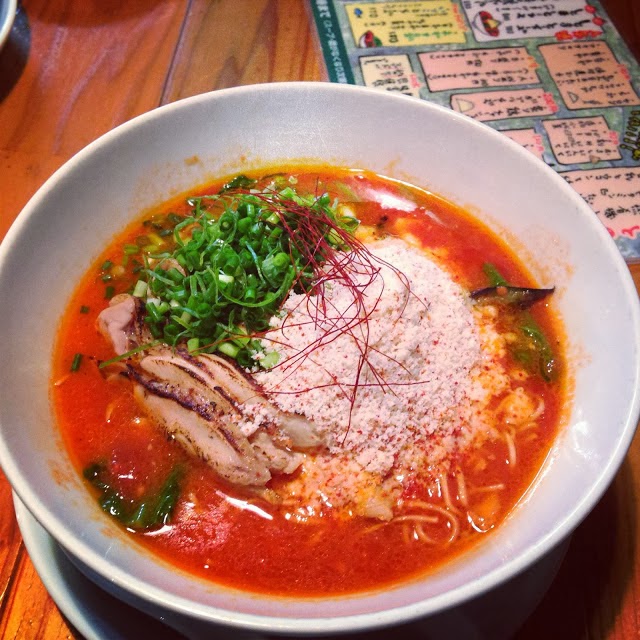 |
| The beautiful goodness of tomato ramen |
Right now I’ve got to say Japanese!
Before coming here my knowledge only extended to sushi and sashimi, but now my
favourites include nabe (a delicious kind of hotpot), shabu-shabu (thinly
sliced meat and vegetables instantly cooked in boiling broth), tempura udon (battered
king prawn with thick noodles in broth), tomato ramen (tomato broth with ramen,
chicken, melted cheese and whatever else you fancy), okonomiyaki (omelette
stuffed with layers of cabbage, bacon, shrimp, rice wafers and barbecue sauce),
chicken nanban (fried chicken with tartar mayo), guidon, tonkatsu and oyakodon (all
combinations of meat and egg over rice). That’s not to mention the sushi –
which is cheaper, fresher and tastier here of course! Are you drooling yet?
 |
| Tempura udon for lunch at school |
If you could live a happy and healthy life without ever needing to sleep
again, would you give it up to save time? Or are you a contented bed bug?
I think I’d save it for weekends –
I’d miss dreaming too much to give it up completely! I read a book once where a
character savoured sleep so much that she could taste it, “like good bacon,
lettuce and tomato sandwich” and I can understand that perfectly! Plus it’s
what happens either side of sleeping that’s interesting ;)
Rainbow fairy lights or white ones?
White for ambience and general
classiness – but you’ve gotta break out the rainbow ones at Christmas.
 |
| Fairy lights galore! |
Are you a good driver? Are you an honest judge of your own driving
abilities? What do you family and friends have to say on the matter?
Much to my dismay, I’ve yet to take
my driving test. It’s number one on the to-do list when I get home. In the mean
time, I pride myself on being an excellent listener, chat partner, and music/
snack provider for my designated drivers.
Would you go into Outer Space if given the opportunity?
Absolutely. My plan is to wait till
I’m old and it’s commercially available, like a bungee jump or deep sea dive.
Then I’ll go see the sun rise on the earth and be jolted out of my old-person
habits, assumptions and cynicisms. Plus if it goes disasterously wrong, I’m
old anyway.
Do you prefer reading/ writing outdoors, in public spaces, or at home in
the peace and quiet?
Reading is best done in peace, quiet
and warmth: either in a sunny patch of a sheltered garden, or lying in front of
an open fire. My favourite place to write, particularly poems, has got to be
public transport – trains preferable, buses tolerable. You have just enough
distraction to be stimulating rather than irritating, an end-point to motivate
you, and a window of unused time to feel completely free and relaxed. Try it!

What’s the best book you read in the past year? Why do you recommend it?
Around this time last year I was
writing my dissertation on media coverage of the Congo conflict, and reading The Poisonwood Bible by Barbara
Kingsolver to try and enhance my knowledge. I’d recommend it to anyone, but
especially if you’re interested in the region, colonialism or anthropology. It
follows the family of an American Bible Belt missionary who move to a village
in the Congo in 1959 just as it is transitioning into the post-colonial era. She
can fool you into thinking you’re reading only about home or guilt or loss –
hefty themes in themselves - when boom! You realise you’ve somehow acquired a
far more nuanced understanding of power and oppression along the way. Aside
from that, Kingsolver’s ability to inhabit the voices of all five women in the
family as they age is extraordinary and utterly convincing (she displays this
virtuosity in her other fantastic novel, The
Lacuna, too). I’ll definitely be re-reading it soon.
And now I present my (12, not 10)
questions for the next round of nominees! Johannah, Francesca, Kayla, I like you and your writing very much and, if you have the time and the inclination, would love to know what you think. Or, if you have only one or neither, no worries - just an invitation :)
Sarah, I’d love to know your answers
to my questions too in the comments section. And that goes for anyone reading this post! Or you could just answer a select few – whatever floats
your boat.
- What is your earliest memory?
- If you could live in any period and place in the world, where and when would it be? You’d be the same person and your family, opportunities etc would be generally the same too. (When we played this at Christmas my uncles answered unequivocally and gloweringly, “Scotland in the days before the smoking ban.”)
- What would your last meal be?
- What’s your favourite book?
- Name eight people, dead or alive, fictional or real, who you’d invite to your ultimate dinner party.
- What is a law, custom, common assumption or norm you would change: why and how? (It can be as serious or as trivial as you like!)
- Describe your perfect day.
- What is something you have learned in the past year? (It can be a skill or specific interesting fact, but general realisations about yourself or the world are more fascinating).
- Name three qualities you most admire and three you most despise in a person.
- Which three places do you most want to go in the world?
- When do you feel most yourself?
- Name a skill/ ability you have and wish you didn’t, and one you don’t have and wish you did. And, one you do have and do enjoy or value, just to end things on a positive note!
Monday, 24 February 2014
writing projects! ave a read
This weekend I skated at a snowy
mountain outdoor rink, sat with my feet in an outdoor onsen, ate Mexican food
in Fukuoka, shopped, and went to a kabuki (traditional Japanese theatre)
festival. I’m exhausted, but it was great to get out of town and shake away the
winter cobwebs.
 |
| Waiting to skate! |
In the quiet exam weeks at school I’ve
been writing a couple of articles. One was for a local newsletter, the
Miyakonojo International Association, about experiencing the turning of the
year as a foreigner in Japan. The other was for an online magazine I used to edit at called Owl Eyes, about the various merits of teaching abroad. Check
them out if you’re vaguely interested in either!
Thursday, 13 February 2014
lazy links: valentine edition

On Valentine's Day in the West, generally men give women flowers, chocolates, dinner dates, jewelry, and women might reciprocate with a card, a gift... or new lingerie. It's consumerist, mass marketed extravaganza, but one between two (hopefully) loving people nonetheless.
In Japan it's a little different. As with so many things here, Valentine's Day involves group obligation, hierarchy, respect, hassle, and putting yourself out to be nice to your community - for women, that is. Yes, it falls only to women to buy chocolates and gifts for their sweethearts and giri-choco or 'obligation chocolate' for their co-workers and bosses. As a result, the holiday seems to be widely resented and less popular co-workers are left with 'token' chocolate, rather than a heartfelt gift. However, in a stroke of genius, chocolate marketers came up with White Day for 14th March, when men can pay back their benefactors in kind.
My students have been handing in homework late because of chocolate-cooking activities (hand-making the treats is popular here), but save for a surprise sent in the post, I'm drawing the line at leaving a box of sweets in the staff kitchen. For first time in 3 years I'll be aloooooone on V Day, and most likely will be celebrating with machination, intrigue and cold blooded revenge. In other words, I have a date House of Cards.
As such, and in an effort to streamline my bookmarks page, my Valentine's gift to you is a round up of my favourite things from around the interwebz of late.
If you have not seen the first season of House of Cards, do not read these recaps via texts from someone's mum.
I used to find this type of post on badly translated signs a little mean, but hilarious. Having spent 6 months grappling with the language and telling people "Watashi wa nihongo ga tabemasen" ("I do not eat Japanese"), I just find them hilarious.
Speaking of signs, someone has been trolling the London Underground recently.
The best ever combination is the cast of Game of Thrones and their cat doppelgangers .
"There are two aspects to the ebook that seem to me profoundly to alter the relationship between the reader and the text. With the book, the reader's relationship to the text is private, and the book is continuous over space, time and reader. Neither of these propositions is necessarily the case with the ebook. "
Why e-Books are a different genre from print .
I'm a sucker for awesome photographs of random subcultures .
The best rendition of Bohemian Rhapsody I've ever seen.
And finally... every couple's Valentine dilemma.
Thursday, 6 December 2012
REVISION
There has been a serious lack of photos/ life events on this blog recently, mainly because my life right now mainly revolves around the library, watching Gossip Girl with no make-up on in my friends' beds, and getting travel vaccinations. None of these contexts are particularly photogenic.
So, I've decided to share my exam procrastination with you in the form of animal-themed links.
1. Cat friend versus dog friend
2. Real birds send messages on Twitter
3. 33 Dogs and Cats that just don't know anymore
4. DOGS
Over and out, until I have a life again.
So, I've decided to share my exam procrastination with you in the form of animal-themed links.
1. Cat friend versus dog friend
2. Real birds send messages on Twitter
3. 33 Dogs and Cats that just don't know anymore
4. DOGS
Over and out, until I have a life again.
Saturday, 24 November 2012
lazy links
Due to a number of things, this week has been somewhat hellish, involving copious amounts of mate tea, essay writing for twelve hours straight several days in a row, a lot of nerves and a horrible meeting.
BUT: it's over now, and has been rounded off with a lovely Thanksgiving dinner. Every year my good friend Sazzle from University Hall has organised a meal: this year it's grown from being around her upturned bed in hall to a table for forty in Madras Clubhouse. We drank good wine, made toasts, and then danced to a Spice Girls medley while the boys washed up!
This weekend will be the first in weeks that I haven't spent in the library. Why hello, novels in coffee shops, vintage fairs and letter writing!
Here are some nice things from the Internetz to celebrate.
BUT: it's over now, and has been rounded off with a lovely Thanksgiving dinner. Every year my good friend Sazzle from University Hall has organised a meal: this year it's grown from being around her upturned bed in hall to a table for forty in Madras Clubhouse. We drank good wine, made toasts, and then danced to a Spice Girls medley while the boys washed up!
This weekend will be the first in weeks that I haven't spent in the library. Why hello, novels in coffee shops, vintage fairs and letter writing!
Here are some nice things from the Internetz to celebrate.
- A very enthusiastic drummer steals the show
- The best surfing video ever
- A pair of best friends, who happen to be 85
- This was me on Wednesday night...
- Kind of wish I'd never seen this
Sunday, 2 September 2012
sunday links
- Old men doing some unfathomable dancing.
- What happens when you try to be completely honest.
- Disney and Dali get together.
- 33 tips on living from a 33 year old.
- These animals are all disappointed in you.
Monday, 20 August 2012
the 5 most adorable children on the internet
1. A 3 year-old explains the plot of Star Wars.
2. A sneaky mom eats all her sons' Halloween candy.
3. Jessica feels good about her day.
4. Another serious 3-year old explains leprechauns.
5. 5 year-old wants a job before marriage.
2. A sneaky mom eats all her sons' Halloween candy.
3. Jessica feels good about her day.
4. Another serious 3-year old explains leprechauns.
5. 5 year-old wants a job before marriage.
Sunday, 12 August 2012
5 things that make me happy to be a human
Postsecret asks fifty people one question.
Dan Savage talks about the secret to being content in your relationship.
Robert Webb recites a poem his girlfriend - now wife - wrote to woo him.
A couple married 62 years entertains people waiting at a clinic.
An African woman plays the guitar in a unique way.
That is all :)
Dan Savage talks about the secret to being content in your relationship.
Robert Webb recites a poem his girlfriend - now wife - wrote to woo him.
A couple married 62 years entertains people waiting at a clinic.
An African woman plays the guitar in a unique way.
That is all :)
Subscribe to:
Posts (Atom)